
Data does not lie. But a metric can still distort behavior when it is asked to become the strategy.
Overall Equipment Effectiveness was designed as a localized tool for understanding availability, performance, and quality losses on a manufacturing line. Used in that context, it can be useful. The trouble begins when OEE becomes the ultimate North Star for an entire operation.
When a metric becomes a target, people learn to optimize the metric. Attention shifts from the health of the industrial system to the appearance of the score.
Tell me how you measure me, and I will behave accordingly.
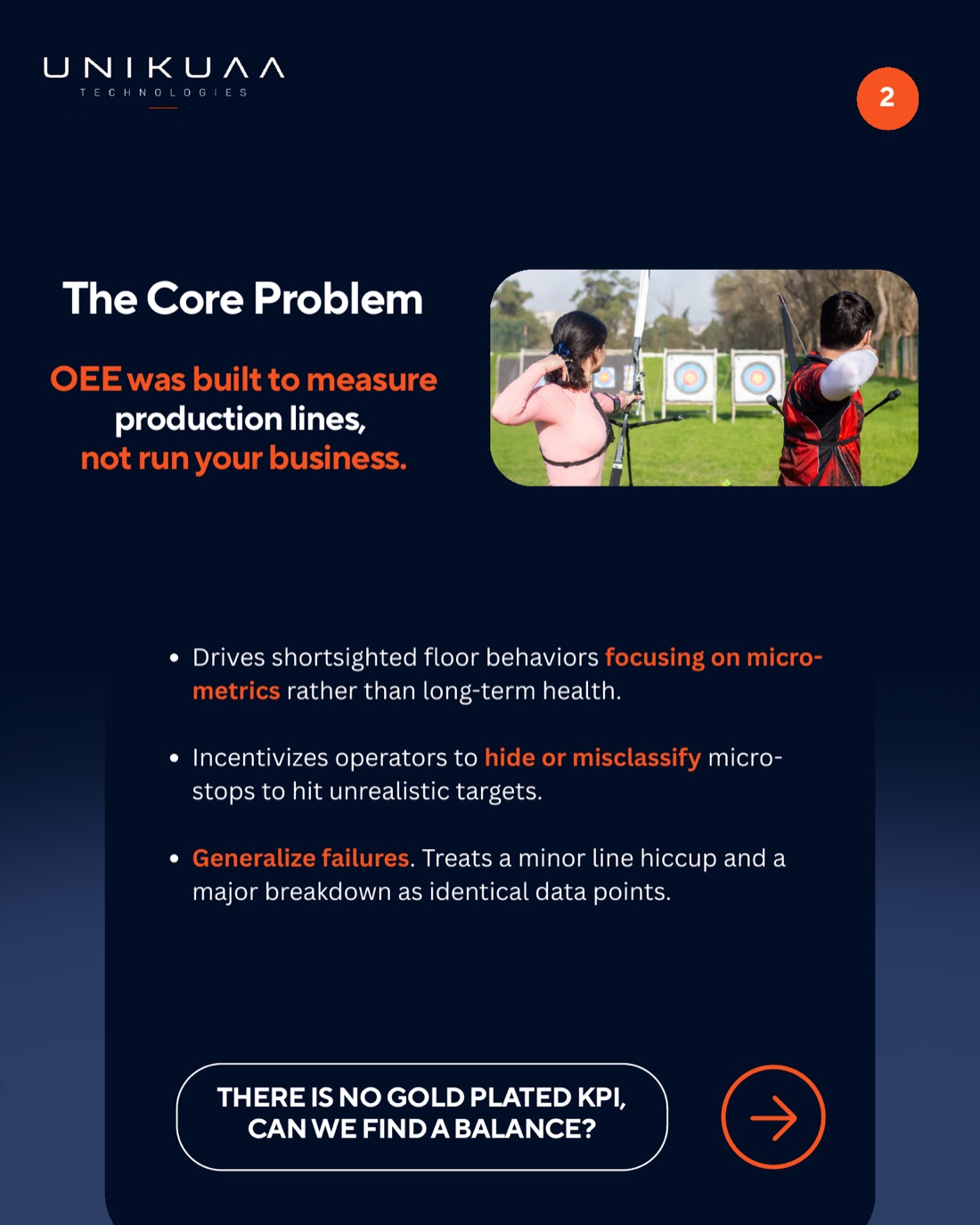
The core problem
OEE compresses very different operational realities into one percentage. That simplicity is attractive, but it can hide the consequences that matter most.
Short-term behavior
Teams focus on today's production result rather than the long-term health of the assets producing it.
Relabeled losses
Micro-stops may be hidden or reclassified when the organization rewards an acceptable percentage.
Generalized failures
A minor label jam and a critical bearing overheat can appear as equivalent downtime even though their risk is not remotely equal.
Silent degradation
A machine can report high availability today while cavitation, thermal stress, contamination, or skipped lubrication moves it toward failure.
The asset-health blind spot
A plant can achieve an impressive OEE result while carrying significant structural risk. OEE does not directly measure component degradation, safety consequence, replacement exposure, the quality of maintenance execution, or the capability of the workforce.
The number may tell us that the line ran. It does not automatically tell us whether the way it ran was sustainable.
A better question
Instead of asking, “How do we maximize OEE?” ask, “Which combination of indicators helps us manage sustainable value?”
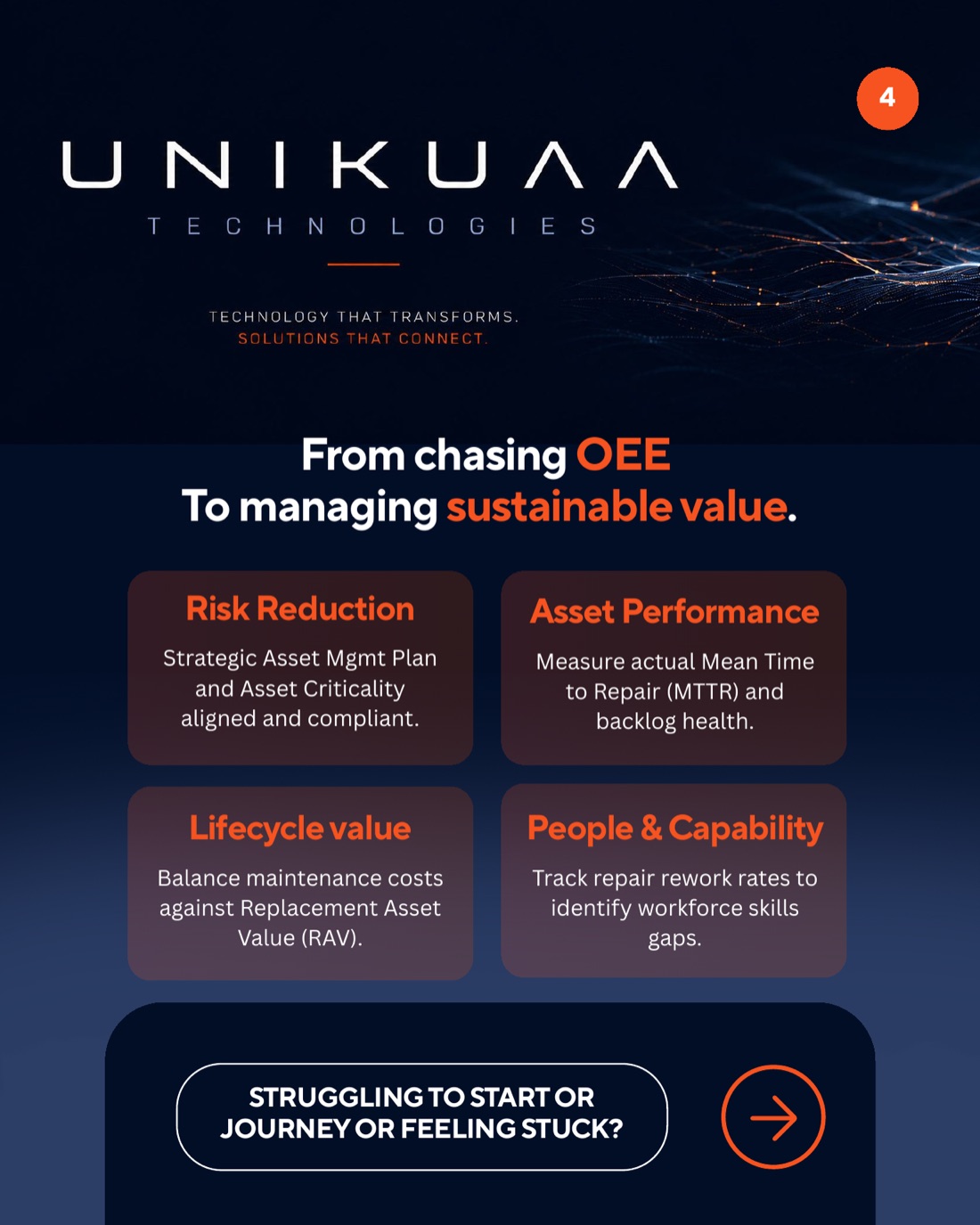
Move from chasing OEE to managing value
Risk reduction
Connect the Strategic Asset Management Plan, asset criticality, safety exposure, and compliance obligations.
Asset performance
Measure failure behavior, actual MTTR, maintenance quality, work management, and backlog health.
Lifecycle value
Balance maintenance cost, risk exposure, capital decisions, and Replacement Asset Value.
People and capability
Track repair rework, execution quality, knowledge gaps, and the operating habits required to sustain improvement.
The original Unikuaa carousel
The five panels below preserve the visual argument shared with the original series.



There is no gold-plated KPI. The goal is balance: production output interpreted alongside asset health, safety, lifecycle value, and workforce capability.
Continue the OEE series on LinkedIn
The earlier posts establish the pressure to maximize output and the behavioral risks of turning OEE into the target.